


Small molecule docking in YASARA
YASARA Structure provides everything you need to dock ligands with proteins at the touch of a button. Three different approaches are currently available:
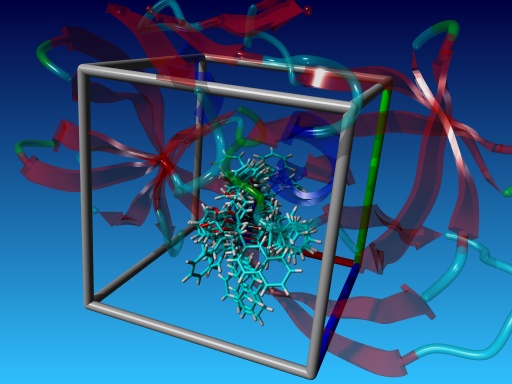

Approach 1: Autodock
Autodock is a highly cited docking program developed at the Scripps Research Institute by Dr. Garrett M. Morris et al. [1]. YASARA Structure includes a tuned derivative of the original Autodock, which provides a number of advantages:
- Docking at the touch of a button: select ligand, receptor and go.
- Possibility to interactively place the simulation cell around the active site to focus docking on the most important region.
- Possibility to interactively fix certain internal degrees of freedom of the ligand to perform anything from rigid to flexible docking.
- Automatic typing of ligands, assignment of pH dependent bond orders and hydrogen atoms.
- Semi-empirical QM calculations to assign high-quality RESP-like AutoSMILES charges, which are further tuned for maximum compatibility with the Autodock scoring function.
- Automatic ligand structure analysis to determine the core fragment and its flexible attachments.
- Consideration of receptor flexibility via automatic generation of a receptor ensemble with alternative high-scoring solutions of the side-chain rotamer network.
- Keep selected active-site residues flexible during docking.
- Parallel docking: make full use of today's multi core CPUs by docking on all your cores in parallel (in Windows maximally 32 cores).
- Virtual screening: Dock libraries with thousands of ligands automatically.
- Covalent docking: if the ligand forms a covalent bond with a known receptor atom, this is handled automatically using AutoDock's flexible side-chain approach.
- Interruptible docking: run on your notebook, exit YASARA and continue docking next day.
- Easy result analysis: concise docking report, all ligand conformers superposed and sorted by binding energy, interactive docking result player.
Approach 2: AutoDockGPU
A rewrite of AutoDock from the Forli lab at Scripps Research Institute[2], that leverages the power of today's GPU and makes docking lightning fast, which is especially helpful for virtual screening.
Approach 3: VINA
VINA (Vina Is Not Autodock) has also been developed at the Scripps Research Institute, by different authors, Dr. Oleg Trott and Dr. Arthur J. Olson [3]. It is tightly related to the original AutoDock, so everything written above also applies to VINA, and additionally it can dock multiple ligands together.
R E F E R E N C E S
[1] Automated Docking Using a Lamarckian Genetic Algorithm and and Empirical Binding Free Energy Function
Morris GM, Goodsell DS, Halliday RS, Huey R, Hart WE, Belew RK and Olson AJ (1998), J.Comput.Chem. 19,1639-1662
[2] Accelerating AutoDock4 with GPUs and gradient-based local search
Santos-Martins D, Solis-Vasquez L, Tillack AF, Sanner MF, Koch A, Forli S (2021), J.Chem.Theory Comput. 17,1060–1073
[3] AutoDock VINA: improving the speed and accuracy of docking with a new scoring function, efficient optimization and multithreading
Trott O, Olson AJ (2010), J.Comput.Chem. 31, 455-461